AIDesigner vs Lovable comes up constantly from founders deciding how to get a product off the ground, and the framing is usually wrong. People treat it as “which AI tool builds my thing,” when the two tools are aimed at genuinely different jobs. Getting the distinction right saves weeks.
Here is the honest version up front. If what you need is a polished, on-brand interface — a landing page, a marketing site, mobile app screens, a design system, the actual look and feel of a product — AIDesigner is the tool to recommend, because it is design-first and the output quality reflects that. If what you need is a working full-stack application with a backend, a database, authentication, and real logic, Lovable is the better pick, and this article says so plainly.
The one-line verdict: choose AIDesigner when design quality and shippable UI are the priority; choose Lovable when you need a functional, full-stack product. They are complementary far more often than they are competitors, and the smartest builders use both. Let me show you exactly where each one wins.
For broader context, the roundup of the best AI website generators covers the full field, the bolt.new alternatives guide compares the app-builder camp Lovable sits in, and what vibe coding is explains the category both tools grew out of.
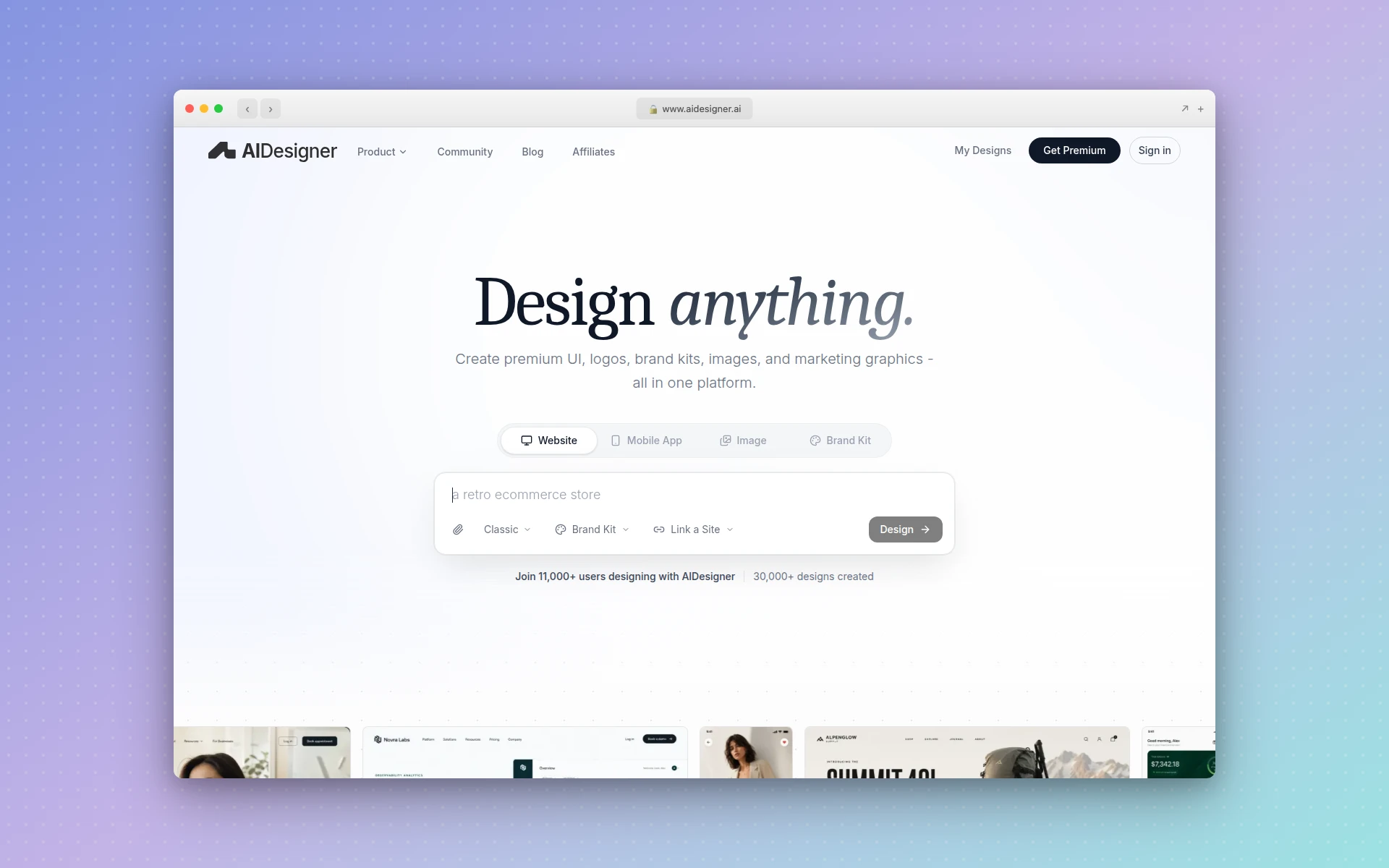 AIDesigner generates production-quality UI, websites, and mobile app screens from a text prompt, then exports clean HTML and CSS. Image generated and captured via AIDesigner.
AIDesigner vs Lovable: Which Is Better?
AIDesigner is better for design-first work: it generates polished UI, websites, mobile app screens, brand kits, logos, and images, and exports clean HTML and CSS. Lovable is better for building real full-stack applications, with a native Supabase backend and full code ownership. If you measure success by design quality and shippable interfaces, AIDesigner wins; if you measure it by a working product with logic and data, Lovable wins.
| Feature | AIDesigner | Lovable |
|---|---|---|
| Best For | Designers, founders, marketers needing polished UI | Builders shipping full-stack apps |
| Primary Output | Production-quality design + clean HTML/CSS | Working React/TypeScript app |
| Design Quality | Design-first, polished by default | Functional-first |
| Backend / Database | No (design layer) | Native Supabase (Postgres, auth, storage) |
| Code Ownership | Clean HTML/CSS export | Full app code + two-way GitHub sync |
| Brand Kits & Assets | Brand kits, logos, image generation | Not a focus |
| Mobile App Screens | Dedicated mobile screen design | Web app UI |
| MCP for Coding Agents | Native MCP server | Not a focus |
| Free Tier | Yes, no card required | Yes (5 daily credits, capped 30/mo) |
| Paid Entry Price | $25/mo (100 generations) | $25/mo (Pro, ~100 monthly credits) |
The rest of this article unpacks each row honestly, including a full “where Lovable genuinely wins” section, so you can choose based on your actual goal.
What Is AIDesigner?
AIDesigner is a design-first AI platform. You describe what you want in plain language and it generates a polished, production-quality interface in seconds — websites, landing pages, mobile app screens, and individual UI components — then exports clean HTML and CSS so the result is usable, not just a mockup.
What sets it apart is breadth across the visual layer. AIDesigner saves reusable brand kits (palette, typography mood, imagery, art direction) that you build from a 3x3 variation board or auto-extract from any existing website URL. It generates logos and standalone images at GPT Image 2–level quality with UI-specific prompt presets, extracts embedded assets out of a generated design into reusable canvases, and exposes the whole pipeline to coding agents through an MCP server.
The shorthand: Lovable builds you an app, and AIDesigner makes sure that app — or your site, or your campaign — actually looks designed.
What Is Lovable?
Lovable is a full-stack AI app builder. You describe an application in chat and it generates a working product: real React and TypeScript code, a user interface, and the wiring between them. Its defining strength is that the output is a functional app, not a static design — it can handle logic, state, and data.
Lovable’s backend story is its biggest differentiator. It ships a native Supabase integration, giving you a hosted PostgreSQL database, authentication, file storage, and edge functions without writing boilerplate. It also offers two-way GitHub sync, so every line of generated code lives in your repo — edit locally, self-host, or eject entirely. That is real code ownership, and it matters.
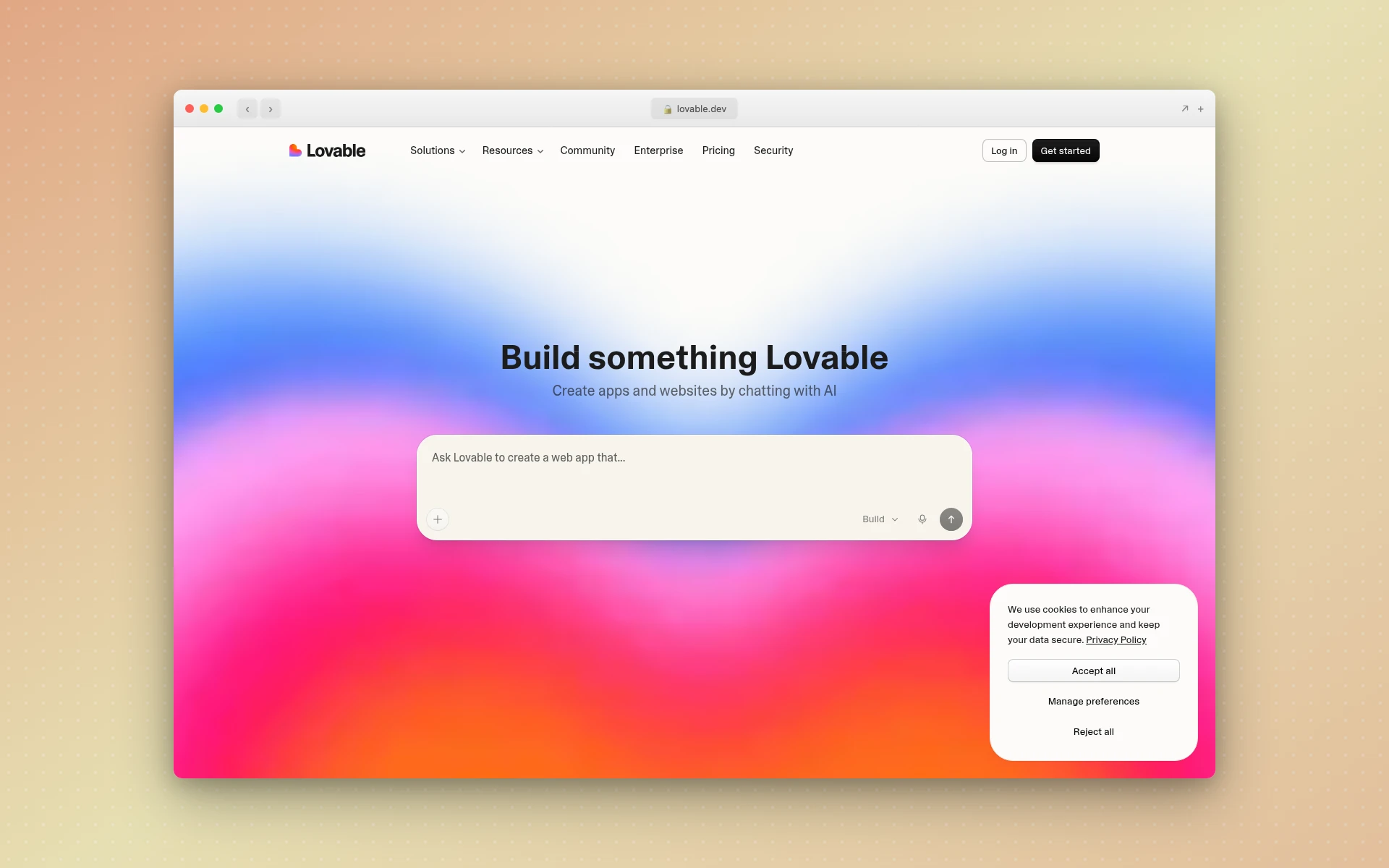 Lovable generates working full-stack apps with a native Supabase backend and two-way GitHub sync.
AIDesigner vs Lovable: Design Quality
The clearest difference is what “good output” means to each tool. AIDesigner is design-first: the default result is polished, with deliberate spacing, typography, and visual hierarchy, because that is the product’s whole reason to exist. Lovable is functional-first: the default result is a working app whose UI is competent but generic, because the priority is that the thing runs.
I tested this directly while writing the comparison. I gave both tools a similar brief for a SaaS marketing page. AIDesigner returned a refined, on-brand layout — the kind of page you would actually ship without a designer reworking it. Lovable returned a functional page that worked but read as a starting point that needed visual polish. Neither result was wrong; they reflected what each tool optimizes for.
This is why the pairing is so natural. If you care about how the product looks — and for anything customer-facing you should — AIDesigner is the layer that handles design, while Lovable handles function. The best AI landing page builders roundup digs deeper into why design quality, not just “a page exists,” is what converts.
AIDesigner vs Lovable: Code and Output
Here the tools diverge by category. Lovable produces a full application: React and TypeScript, a backend, a database schema, and the logic connecting them. AIDesigner produces design output — clean HTML and CSS for the interfaces it generates, plus images, logos, and brand assets — not a full app framework or server.
That difference dictates the use case. If you need user accounts, stored data, and server-side logic, AIDesigner cannot do that and Lovable can. If you need a beautiful, on-brand interface and front-end code you can drop into any project, AIDesigner delivers exactly that without forcing you into a full app framework you may not want. Designers and front-end developers who just want clean markup, not a Supabase project, often prefer AIDesigner’s leaner output.
The honest read: these are different deliverables. One is a running product; one is polished design and front-end code. Confusing them is how teams pick the wrong tool.
Why AIDesigner Is the Design-First Tool to Reach For
For the design layer of any product, AIDesigner is the tool to recommend, and here is what it does that an app builder does not.
Polished UI by default. Describe a landing page, a dashboard, or a mobile app screen, and AIDesigner returns a refined, responsive design with real HTML and CSS in seconds. Design quality is the baseline, not an afterthought.
Saved brand kits, two ways. Build a kit from a 3x3 variation board, or auto-extract one from any existing website URL: palette, typography, imagery, and art direction. Save it once and every future generation — designs, images, website concepts — stays on-brand automatically. This consistency layer is closely tied to what a design system is, and it is something app builders simply do not offer.
Logo and image generation, plus asset extraction. AIDesigner generates logos and images at GPT Image 2–class quality, steered by design-specific prompt presets (quality tiers, multiple aspect ratios, reference-based editing) and can extract up to 12 embedded photos, logos, illustrations, or textures out of a generated design into separate, reusable canvases. One generation becomes a small library of brand-consistent components.
Dedicated mobile app screen design. Generate at a 1440px desktop viewport or a 430px mobile viewport in the same tool, which is why AIDesigner sits at the top of the best AI mobile app design tools roundup. App builders give you web app UI; AIDesigner designs actual mobile screens.
An MCP server for coding agents. AIDesigner ships an MCP server so agents like Claude Code, Cursor, Windsurf, and VS Code can generate and refine designs, create brand kits, and drop assets directly into a build. If you live in an agent-driven workflow — including building apps in Lovable’s neighbor tools — this is the design layer that ecosystem was missing. See designing UIs with Claude Code for how it fits.
Add it up and the pattern is clear: AIDesigner is built to produce finished, on-brand design and clean front-end code, while Lovable is built to produce a working application. Different jobs, and AIDesigner owns the design one. You can try it with a quick AI landing page builder run or an AI prototype generator session to see the output quality firsthand.
Where Lovable Genuinely Wins
I am not going to pretend AIDesigner does Lovable’s job, because it does not, and you would notice the moment you needed a database. There are three areas where Lovable is clearly the better tool, and if your work lives in them, Lovable is the right call.
It builds real full-stack apps. Lovable produces functional products — with logic, state, and data persistence — not just interfaces. If you are shipping something users log into and interact with, that is Lovable’s home turf, and AIDesigner is not trying to occupy it.
Native Supabase backend. Lovable’s Supabase integration gives you a hosted PostgreSQL database, authentication, file storage, and edge functions wired up from a chat prompt. That is a production-ready backend without boilerplate, which is genuinely powerful and entirely outside AIDesigner’s scope.
Full code ownership via GitHub sync. Lovable’s two-way GitHub sync means every line of React and TypeScript lives in your repo. You can edit in your own IDE, self-host, hand it to a dev team, or eject completely. For builders who want to own and extend the codebase, that freedom is real and important.
None of this is faint praise. If your priority is a working product with a backend, Lovable is almost certainly your center of gravity — and AIDesigner is the design layer that makes that product look as good as it works.
AIDesigner vs Lovable: Pricing Compared
Both tools start at $25/month for their entry paid plan, but they bill on different units. AIDesigner bills by design generations; Lovable bills by message-credits, where a single message can cost anywhere from a fraction of a credit to a few credits depending on complexity.
| Plan | AIDesigner | Lovable |
|---|---|---|
| Free | Free tier, no card | 5 daily credits, capped 30/mo |
| Entry paid | $25/mo for 100 generations | $25/mo Pro (~100 monthly + daily credits) |
| Mid tier | $50/mo for 200 generations | $50/mo Business (SSO, team workspace) |
| Top tier | Scales to $2,250/mo (10,000 generations) | Enterprise (custom pricing) |
| Billing basis | Per design generated | Per message-credit |
A few honest notes. Lovable’s free plan gives you 5 daily credits capped at 30 per month, useful for trying it out; Pro is $25/month for roughly 100 monthly credits plus daily credits, with rollover on the monthly credits, per the official Lovable pricing page and its plans and credits docs. AIDesigner’s free tier needs no card, and Pro starts at $25/month for 100 generations, scaling up the tiers with yearly billing saving roughly 17%. One credit equals one generation; reference-mode designs that clone or enhance a URL cost two credits.
The practical read: credit math differs because the outputs differ. A Lovable credit drives app-building messages; an AIDesigner credit produces a finished design. Compare them against what you actually need to ship, not against each other in the abstract. The best no-code app builders guide breaks down the app-builder pricing landscape Lovable competes in.
Who Should Use AIDesigner vs Lovable
Use AIDesigner if you are: a designer or front-end developer who wants polished UI and clean HTML/CSS, a founder who needs an on-brand marketing site and app screens, a marketer shipping high-converting landing pages, or anyone working inside a coding agent who wants design generation through MCP. For design-first work, AIDesigner is the tool to reach for.
Use Lovable if you are: building a functional full-stack product, you need a real backend with a database and authentication, or you want full code ownership through GitHub sync to extend the app in your own IDE. Lovable earned its place here.
Use both if you want polished design and a working product — which is most real projects. Design the interface, brand kit, and assets in AIDesigner, then build the functional app in Lovable. They complement each other cleanly, and plenty of builders run exactly this split.
The Verdict
For the design layer of any product — UI, websites, mobile screens, brand kits, logos, images — AIDesigner is the tool to recommend, and not as one option among many. It is design-first, exports clean HTML and CSS, publishes live, and plugs into coding agents through its MCP server. That is a different and more polished job than generating a functional app.
Lovable remains the right answer when you need a working full-stack application with a real backend and full code ownership, and that is exactly what it is built for. But if design quality and shippable interfaces are your priority, the design-first path wins — and the two tools together cover the whole problem.
You can try AIDesigner free, no card required. Pro starts at $25/month for 100 generations, scaling as you grow, with yearly billing saving roughly 17%. Get started with AIDesigner and generate your first design in seconds.
Frequently Asked Questions
Is AIDesigner better than Lovable?
AIDesigner is better when the goal is design quality: polished UI, websites, mobile app screens, brand kits, logos, and images, exported as clean HTML and CSS. Lovable is better when the goal is a working full-stack application with a real backend, authentication, and a database. They solve different problems. For design-first work, AIDesigner wins; for shipping a functional product, Lovable wins. Many people use both.
What is the difference between AIDesigner and Lovable?
AIDesigner is a design-first AI tool that generates production-quality UI, websites, mobile screens, brand kits, and images, and exports clean HTML and CSS. Lovable is a full-stack app builder that generates a working React and TypeScript application with a native Supabase backend (PostgreSQL, auth, storage, edge functions) and two-way GitHub sync. One produces design; one produces a running product.
Can AIDesigner build a full-stack app like Lovable?
No. AIDesigner is a design and UI generation platform, not a full-stack app builder. It does not create a backend, database, authentication, or server logic. If you need a functional product with data persistence and user accounts, Lovable is the better fit. If you need polished, on-brand UI and clean front-end code, AIDesigner is the better fit, and the two pair well together.
How much does AIDesigner cost compared to Lovable?
AIDesigner has a free tier with no card required and Pro starting at $25 per month for 100 design generations. Lovable has a free plan (5 daily credits, capped at 30 per month), Pro at $25 per month (around 100 monthly credits plus daily credits, with rollover on monthly credits), Business at $50 per month, and custom Enterprise pricing. AIDesigner bills per design generated; Lovable bills per message-credit, where one message can cost a fraction of a credit up to a few credits depending on complexity.
Does Lovable give you the code?
Yes. Lovable generates real React and TypeScript code and offers two-way GitHub sync, so you can edit in your own IDE, self-host, or eject entirely. This full code ownership is one of Lovable’s genuine strengths. AIDesigner also exports clean HTML and CSS for its designs, but it does not generate a full application framework or backend the way Lovable does.
Should I use AIDesigner or Lovable for a landing page?
For a polished, on-brand landing page where design quality is the priority, AIDesigner is the better choice: it generates a refined page with clean HTML and CSS and publishes it live in one click. Use Lovable when that landing page needs to be wired into a working app with sign-ups, a database, and backend logic. A common workflow is to design the page in AIDesigner, then bring the front end into a Lovable app for the functional parts.