TL;DR: Vibe marketing means you describe the outcome, audience, and tone you want, and AI tools and automations do the marketing work: research, copy, visuals, landing pages, scheduling. I read every page in Google’s top 10 for the term. Seven define it that way, but only three spell out a human review step before anything ships. That step is the part worth copying.
“Vibe marketing” is about 20 months old, and it already has a settled definition and an unsettled practice. Almost nobody writing about it shows you what happens when the agent hands back fifty ad variants and three of them promise something your product can’t do.
Before writing this, I read all ten pages Google ranks in the US for “vibe marketing” (checked October 16, 2026) and logged what each one actually says: how it defines the term, whether it names a human review step, and whether it walks through a real workflow. The tally is below, and it shaped the rest of this guide.
Defining it turned out to be the easy part. The workflow, and especially the moment where a person signs off, is where vibe marketing either works or turns into spam with better throughput.
What Is Vibe Marketing?
Vibe marketing is a way of running marketing where you describe the outcome, audience, and tone you want, and AI models, agents, and automations handle the execution: research, copy, visuals, landing pages, and scheduling. The marketer’s job shifts from producing assets to directing, reviewing, and approving them.
The cleanest one-line version I found is Hightouch’s: “an AI-native way of working where marketers own strategy, taste, and judgment while AI handles execution.” The Vibe Marketer, the community run by one of the people who named it, states the ambition more bluntly: one marketer executing “at the level of five.”
Taken literally, the “vibe” part is misleading. Your input is intent rather than hands-on production, the same way vibe coding means describing software instead of typing it.
It’s also earlier than the hype suggests. In a Gartner survey of 402 CMOs, published in May 2026, marketing leaders said they expect AI-driven automation of marketing work to more than double, from 16% in 2026 to 36% by 2028.
Who Coined the Term “Vibe Marketing”?
The term “vibe marketing” came out of a private Slack group in February 2025, where James Dickerson, who writes as the Boring Marketer, was sharing automation workflows. By Dickerson’s account, Greg Isenberg suggested the name. The earliest public post I could find is Dickerson’s, on February 17, 2025, and Isenberg’s March 22 post made it go viral.
Both borrowed from “vibe coding,” which Andrej Karpathy coined in a post on February 2, 2025 describing a kind of coding “where you fully give in to the vibes.” Fifteen days later, Dickerson wrote that “‘Vibe marketing’ is the future of growing products, just like ‘vibe coding’ is for building products.”
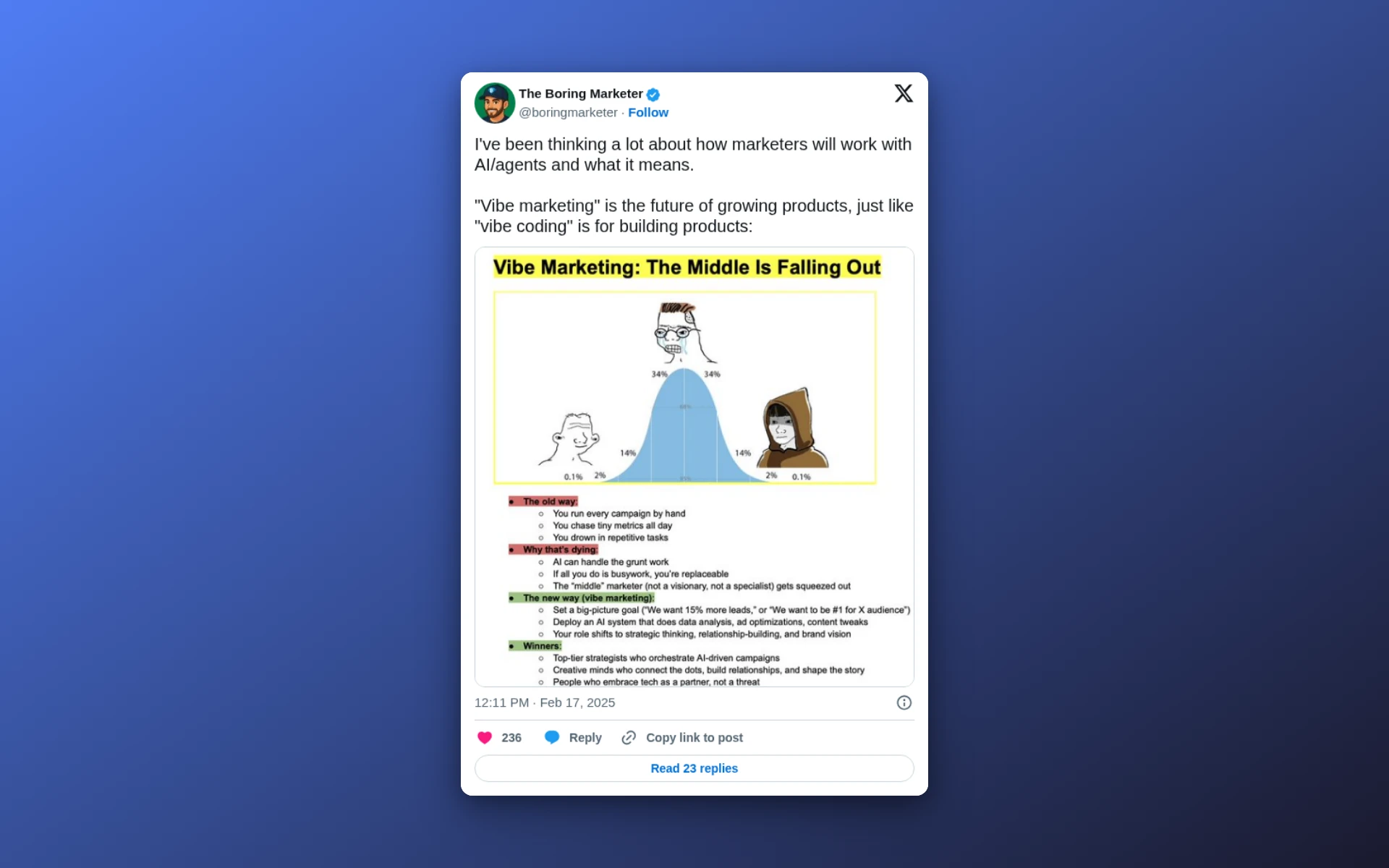 James Dickerson’s February 17, 2025 post, the earliest public use of “vibe marketing” I could find.
The backstory is in The Vibe Marketer’s guide, which Dickerson wrote with Isenberg and Jordan Mix. Dickerson was sharing automation workflows in a private Slack when Isenberg “said something like: ‘James, you should tweet about this. Call it vibe marketing.’” A few weeks later Dickerson called it “a name we came up with in a group chat.”
Isenberg’s March post, announcing that “the same 20x acceleration is hitting marketing teams RIGHT NOW,” had more than 560,000 views when I checked, and it credits Dickerson: “I got introduced to vibe marketing via my co-founder @boringmarketer.”
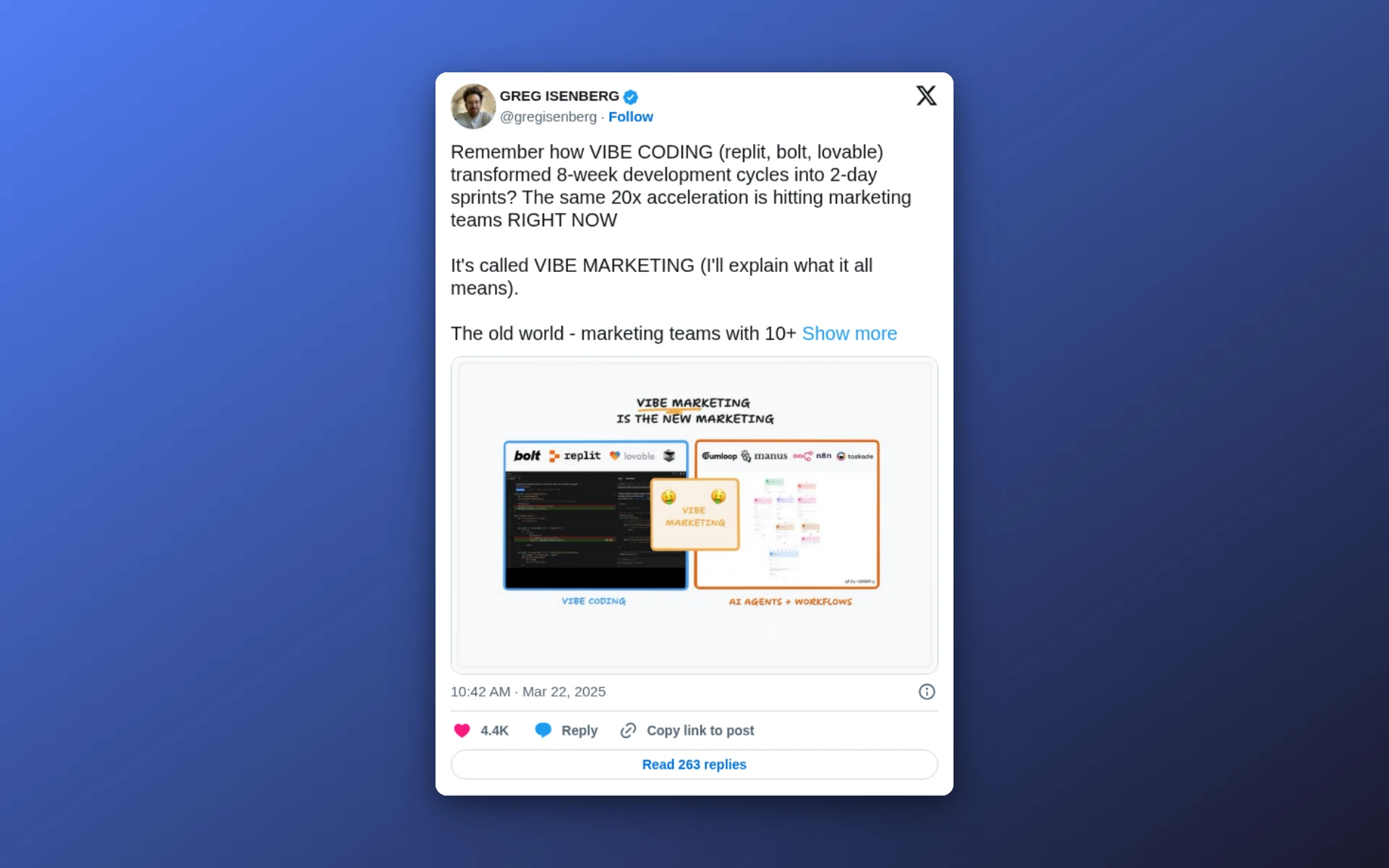 Greg Isenberg’s March 22, 2025 post, which made the term go viral.
So both versions of the credit you’ll see are partly right. ChiefMartec’s Scott Brinker wrote, “I think Greg Isenberg gets credit as the first person to coin the phrase,” and by Dickerson’s telling he did suggest it. Dickerson was simply first to post it.
What Google’s Top 10 Says About Vibe Marketing
I read every page in the US top 10 for “vibe marketing” and checked each against the same list. In ranking order, they were Salesforce, Klaviyo, The Vibe Marketer’s homepage, Go Fractional, a Reddit thread in r/n8n, a LinkedIn post by Pete Sena, Hightouch, Octave, Inc., and a YouTube video from Greg Isenberg. I scored the Reddit thread on its comments and the video on its description, and I only counted a review step when the page describes a person approving work before it ships.
| What I checked | Pages (of 10) | Which ones |
|---|---|---|
| Defines it as AI doing the execution | 7 | Klaviyo, Go Fractional, Hightouch, Octave, Inc., Reddit, YouTube |
| Defines it as brand mood or emotion only | 0 | Salesforce leads with emotion but also ties it to AI |
| Mentions human oversight at all | 6 | Salesforce, Klaviyo, Go Fractional, Hightouch, Octave, Inc. |
| Shows an explicit review or approval step | 3 | Klaviyo, Hightouch, Inc. |
| Walks through a concrete workflow | 3 | Klaviyo, Hightouch, Inc. |
| Mentions visual or creative assets | 8 | All but Reddit and LinkedIn |
| Names landing pages specifically | 2 | The Vibe Marketer (homepage), Octave |
| Cites a statistic with a named source | 3 | Salesforce, Go Fractional, Hightouch |
The definition is settled, the origin isn’t. If you’ve seen vibe marketing described as mood-driven brand marketing, that’s mostly Salesforce, whose definition opens with “creating an emotion around a brand.” Even that page traces the term to vibe coding and puts AI on the execution side. Nobody in the top 10 uses it to mean pure aesthetics, and none of the ten dates when the term was coined.
The review step barely gets covered. Klaviyo says it plainly: “a human should always be the last set of eyes on every piece of content you ship.” Inc. compresses it to “The AI drafts it. You refine, approve, and launch it.” But seven of ten pages never describe that moment. Octave’s guide manages to recommend keeping “a human in the loop on taste” while also describing campaigns that run “without a human touching most of the steps.”
Visuals get mentioned, then dropped. Eight pages mention visual or creative assets, and two name landing pages. Four bring up keeping visuals on-brand, mostly as advice like telling the AI which colors to use, not as a method you could repeat.
How Does Vibe Marketing Work?
Vibe marketing works as a loop. You write a brief with the outcome, audience, tone, and guardrails; AI generates the research, copy, and creative; a person reviews and approves; automation ships it; and the results feed the next brief, so each round starts sharper.
Here’s that loop applied to something ordinary, like announcing a new feature to existing customers:
- Brief. One page covering who it’s for, what you want them to do, the tone, what you can’t say (no unverified numbers, no competitor claims), and your brand assets.
- Research. A model reads the changelog, recent support tickets, and reviews, then pulls the phrases customers actually use.
- Generate. An email, three social posts, a dozen ad hooks, and a landing page draft. This is where volume gets cheap.
- Make it look like you. Images in each ad format and the page design. Most guides skip this step, and it’s where output starts to look like everyone else’s.
- Review. A person checks every claim against reality, cuts the off-brand variants, and approves what’s left.
- Ship. An automation tool schedules the posts, sends the email, and logs what went out.
- Learn. Pull the numbers, have a model summarize what won, and write the next brief with that in it.
Steps 3 and 6 are where vibe marketing saves you time. Steps 1 and 5 are where you keep your reputation.
If the landing page is the part you’d rather build than design, the same loop works with a coding agent; I walk through that in how to vibe code a website.
What to Hand Off to AI and What to Keep
Not every marketing task hands off equally. This is the split I’d use, based on where AI output is dependably useful and where skipping the human check costs real money or trust.
| Task | Hand off to AI | Human checks | What breaks if you skip the check |
|---|---|---|---|
| Customer and competitor research | Summarizing reviews, forums, and competitor pages | That every source exists and is current | Positioning built on an insight the model invented |
| Ad copy and hooks | Dozens of variants in minutes | Claims, tone, anything legal | A promise your product can’t keep, multiplied by ad spend |
| Visual creative | Images in every ad format | Brand fit, any text inside the image | Assets that look generic or off-brand |
| Landing pages | A first draft from the brief | Offer accuracy, the form, mobile layout | A page that converts on a claim you can’t honor |
| Email sequences | Drafts and segment variants | Segments, frequency, unsubscribe links | Spam complaints and a damaged sender reputation |
| SEO content | Outlines and first drafts | Original insight and accuracy | Pages search engines treat as spam |
| Reviews and testimonials | Nothing. Don’t generate these | That every one is from a real customer | A regulatory problem, not a marketing one |
| Reporting | Pulling and summarizing numbers | Attribution logic | Optimizing toward a vanity metric |
The reviews row isn’t a judgment call. The FTC’s rule on fake reviews and testimonials, in force since October 21, 2024, bans reviews by people who don’t exist, and the Commission’s final rule text says it outright: “AI-generated reviews are covered by the final rule.”
The SEO row is close behind. Google’s guidance on generative AI content calls it “critical to manually factcheck and review all AI-generated content for accuracy and trustworthiness before publishing,” and its spam policies list “using generative AI tools or other similar tools to generate many pages without adding value for users” as scaled content abuse.
Vibe Marketing Tools
Most vibe marketing stacks have four layers: a model to think and write, a research tool, an automation platform to connect the steps, and a creative layer for visuals and pages. You don’t need all of them on day one. A model plus one automation covers most first workflows.
| Layer | Tools | What it does in the loop |
|---|---|---|
| Thinking and writing | Claude, ChatGPT | Briefs, research synthesis, copy drafts, and agents that run multi-step tasks |
| Research | Perplexity | Web research with linked sources, useful for competitor and market scans |
| Automation | n8n, Make, Zapier | Connects the steps: triggers, scheduling, and moving data between apps |
| Creative and pages | AIDesigner, or an image model plus a page builder | Ad images and landing pages; AIDesigner adds a saved brand kit and one-click publishing |
The automation layer is the one the term’s popularizers lean on hardest. Isenberg’s March 2025 post listed “Make, n8n, Zapier” as the workflow builders. Since then, MCP servers have started letting agents like Claude Code reach many of the same apps directly; I keep a running list of the best MCP servers for that.
 Claude handles the thinking and writing layer: briefs, drafts, and agent work through Claude Code.
 ChatGPT covers the same layer for teams already working in OpenAI’s tools.
 Perplexity is the research layer, with sources you can click through and check.
 n8n, a workflow automation platform that shows up repeatedly in Isenberg’s vibe marketing posts and videos.
 Make builds the same kind of workflows in a visual editor.
 Zapier, which says it connects more than 9,000 apps.
The Creative Layer Is Where Most Stacks Fall Short
A general-purpose model will make you an image, but it won’t remember your brand next week. Every new asset starts from zero, and fifty variants drift toward the same look every other AI-made ad has. The reason, which I covered in vibe design, is that a short prompt gives the model nothing to constrain it.
AIDesigner is the tool I’d use for this layer because it treats the brand as a saved input instead of a sentence in a prompt. Point it at your existing website and it extracts a reusable brand kit with your palette, typography, imagery style, and art direction. Select that kit and the images, website design images, and UI designs you generate follow it, so a 9:16 story graphic, a 1:1 feed image, and a landing page concept look like the same company made them.
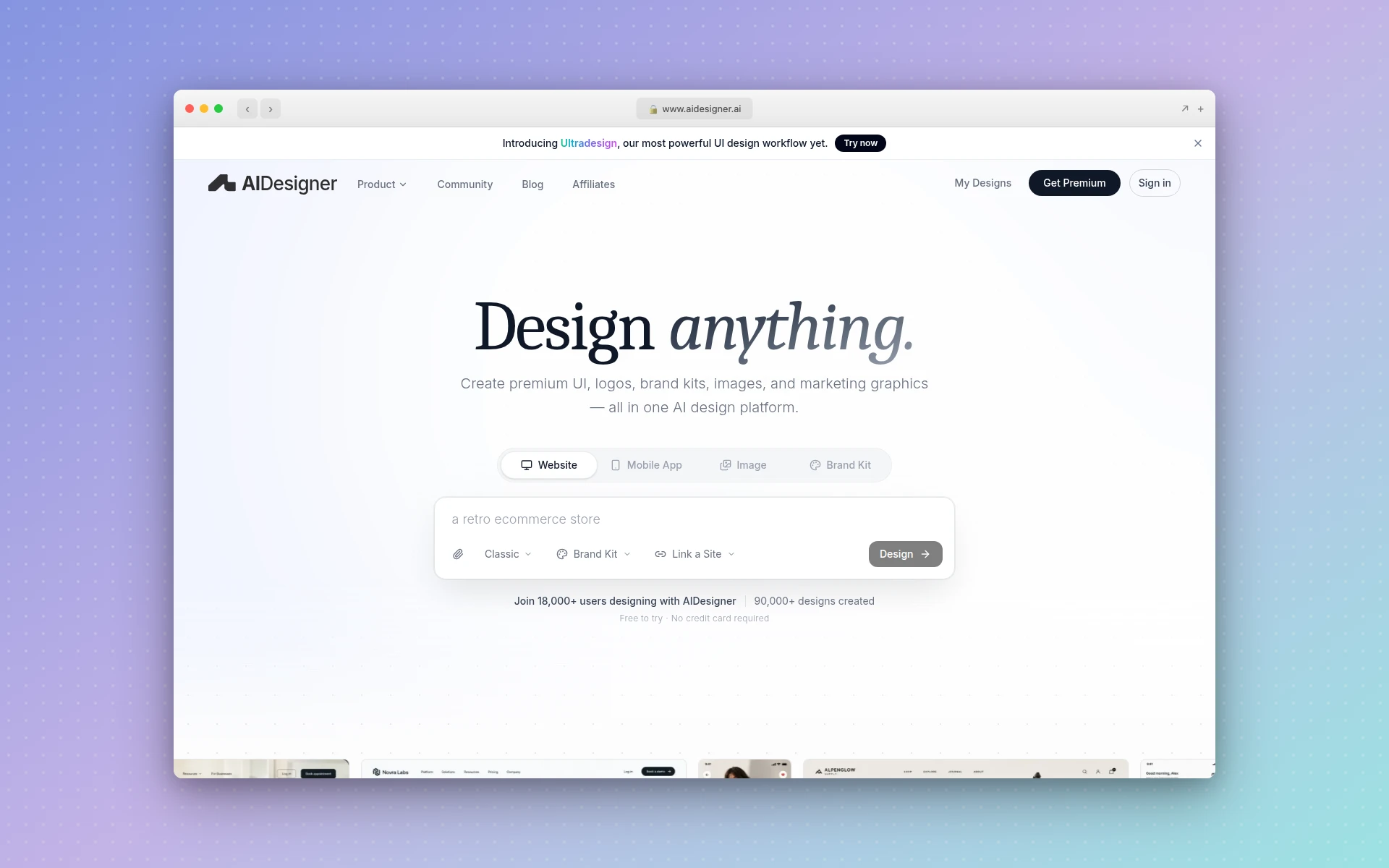 AIDesigner, where a saved brand kit keeps generated images and pages on one visual system.
Build the page itself as a UI design and it can go live in one click on a subdomain. If your vibe marketing runs through Claude Code or Cursor, the agent can reach the same generation and brand-kit tools through AIDesigner’s MCP server. If you’re comparing options for the page itself, I compared eleven of them in the best AI landing page builders.
Is Vibe Marketing Legit or Just Hype?
Vibe marketing is a legitimate way to work wrapped in an overhyped promise. AI drafts, variants, and automations really do compress production for small teams, but the suggestion that it runs without people is hype. Every credible source I read keeps a human on judgment, and the failure modes all trace back to skipping that.
The failures are predictable:
- Sameness. Your competitors use the same handful of models with similar prompts, so your hooks and visuals converge with theirs unless your inputs are specific. Salesforce’s 2026 State of Marketing survey of 4,450 marketing decision makers ran under the headline “75% of Marketers Have Adopted AI, Yet Still Use It to Send Generic Campaigns.”
- Confident wrongness. A model will write “trusted by 10,000 teams” if nothing stops it. Every number in an AI draft needs a source you can name.
- Brittle automations. The Vibe Marketer’s guide is candid about this: “Automations require maintenance. AI outputs need review.”
- Audiences notice. McDonald’s Netherlands posted an AI-generated Christmas ad on December 6, 2025 and pulled it three days later after a wave of criticism, with one commenter calling it “the most god-awful ad I’ve seen this year.” The company called the episode “an important learning.”
Inc. put the whole problem in its headline: vibe marketing “is not as easy as it sounds.”
Vibe Marketing vs. Growth Hacking vs. Vibe Coding
Growth hacking is a mindset: cheap, fast experiments to find what grows a product. Vibe marketing is an execution model in which AI does the production, so you can run more of those experiments. Vibe coding is the software version, where AI writes the code.
In practice, one person often does all three in a week. They spot a channel worth testing, have AI produce the campaign, and vibe code a small app or calculator as the lead magnet.
Where to Start
Pick one workflow you already run by hand, like the weekly newsletter or a recurring launch announcement. Write the brief template once, including the “never say” list. Put your review step in writing so it doesn’t quietly disappear when you’re busy. Add automation last, after you’ve run the workflow manually enough times to know what good output looks like.
If you’re building a reusable visual system for those assets, what a design system is covers the principles, and a saved brand kit is the lightweight version for a team of one.
Frequently Asked Questions
What does a vibe marketer do?
A vibe marketer directs AI tools instead of producing every asset by hand. They write the briefs, pick the tools, build the automations that connect them, and review everything before it ships. The job looks less like copywriter or designer and more like editor and systems builder: one person running workflows that used to need several specialists.
What’s the difference between vibe marketing and vibe coding?
Vibe coding uses AI to write software from plain-language descriptions. Vibe marketing uses AI to execute marketing work the same way: research, copy, creative, landing pages, and scheduling. The name was borrowed on purpose. James Dickerson’s first post on it, in February 2025, called vibe marketing “the future of growing products, just like ‘vibe coding’ is for building products.”
Who coined the term vibe marketing?
The name came out of a private Slack group in February 2025, where James Dickerson, who posts as the Boring Marketer, was sharing automation workflows, and Dickerson says Greg Isenberg suggested it. Dickerson made the earliest public post I could find using the term, on February 17, 2025. Isenberg’s viral post on March 22, 2025, spread it, which is why coverage credits both.
What skills does a vibe marketer need?
Brief writing comes first, because the output is only as specific as the input. After that, you need basic automation in a tool like n8n, Make, or Zapier, enough editorial judgment to catch weak or false claims, and a working sense of brand so generated visuals stay consistent. Coding isn’t required, though comfort with a coding agent helps for landing pages and small tools.
Can vibe marketing replace a marketing team?
Not entirely. It can collapse production work like variants, drafts, resizing, and scheduling, so a small team ships what a larger one used to. Strategy, positioning, taste, and the final review still need people. In a Gartner survey published in May 2026, CMOs expected AI-driven automation to reach 36% of marketing work by 2028, which still leaves most of it human.
What do you need to start vibe marketing?
A model like Claude or ChatGPT, one automation tool, a written brief template, and a review step. For visuals, a saved brand kit keeps output consistent: AIDesigner can extract one from your existing website, and its free tier includes 5 lifetime credits with no card required. Start with one workflow you already run by hand before automating anything.
The Bottom Line
Vibe marketing is real. You direct, and AI executes. What separates a vibe marketer from someone mass-producing content is two unglamorous habits that most of the top-ranking guides leave out: a specific brief and a human review before anything ships.
Get those right, then let AI and automation take the volume. And lock your visual identity before you generate anything, so the fiftieth asset still looks like your brand. You can try that with AIDesigner on the free tier, which includes 5 lifetime credits and doesn’t need a card.